Wednesday, March 23, 2011

Concerns about the coming months

My previous post described the situation in Tokyo and explained why I thought there was no reason to leave Tokyo at that time. There have been a couple of developments that are cause for concern though.

Power shortage in eastern Japan

As I mentioned before, residents in the suburbs of Tokyo have been coping with scheduled power cuts. Tokyo Electric Power Company (TEPCO) have started publishing their daily electricity demands and capacity. Here's a snapshot for today:


They're updating this in real time. As you can see, the efforts being made to save electricity are paying off. This year's demand is substantially lower than last year's. The corridors in my office are dark, the hand driers are switched off in the toilets and escalators have been cordoned off. However, we're dangerously close to full capacity. Last week, TEPCO issued an emergency warning stating that a power cut could occur at any moment due to high levels of demand. My whole office was told to go home at 4:30pm.

So we're struggling now, and it's only March. Demand for electricity will go through the roof in the summer and TEPCO is already warning that power cuts may occur during the summer months. I am NOT looking forward to relentless 35 degree humidity day and night with no air conditioning. This post at Spike Japan takes a detailed look at the situation and the outlook is not good. In addition to the Fukushima nuclear power plants, there are a large number of other power plants that are no longer functioning. Looking at the numbers, it looks highly unlikely that supply will be able to meet demand in the summer.

Foodstuffs and Drinking Water

With the exception of those living in the immediate vicinity of the Fukushima powerplants, radiation carried through the air has so far been a non-issue. This site has an excellent set of graphs showing radiation readings taken in various locations in Japan. Tokyo appears fine.

Food and drink is another issue. The government has already moved to deal with contaminated milk, spinach and other foods that are produced in Fukushima. Today, the Tokyo water department has stated that infants should not consume tap water due to high levels of radioactive iodine. I have a 9-week-old baby boy. The shelves in supermarkets are already empty most of the time as people buy rice, bread and other basics. Similar panic buying of bottled water could be unpleasant for those with infants.

Wednesday, March 16, 2011

To People Worried About Us in Japan

A note to all of my friends who are worrying about us here in Japan.

We seem to be in a situation where the global media coverage has caused more panic abroad than in Japan, which is remarkble. While the concern is touching, my fellow expats in Japan and I are spending a lot of time reassuring friends and family. I'm going to try and write about what things are like over here for us.

For those of us in Tokyo, the earthquake on the 11th did relatively little damage. All of the horrific images and videos that we have seen have come from areas north of Tokyo – specifically the Miyagi, Iwate and Fukushima prefectures. Almost all of this damage was done by the tsunami that followed the earthquake, which demolished defenses that had never been designed for such an onslaught.

Life here in Tokyo has mainly been affected by two things.

The first is a power shortage due to power plants outside Tokyo being damaged or taken offline. The nuclear plants in Fukushima are an obvious example. We are all being encouraged to be conservative with our electricity usage and for certain sections of the Tokyo area, scheduled power cuts are taking place. I haven’t experienced one yet. The biggest impact of the power shortage is on the trains. Tokyo’s trains do an outstanding job of transporting a phenomenal number of commuters every day. At my local station at rush hour, a train comes along every couple of minutes. The number of trains running was reduced dramatically on Monday meaning that crowding was severe and it was very hard to get into work. I’m very pleased to report that the situation has improved drastically and most trains are running very well today, two days later.

The second is a succession of aftershock earthquakes that continue to rock eastern Japan. There are a lot of these (maybe 30 a day?) and some of them are quite strong – we had one last night that was magnitude 6.2. They’re very unnerving but none of them have been as powerful as the first earthquake and none of them have caused any damage in Tokyo.

As a result of both of these things, people in Japan are buying all of the rice, noodles, bread etc. available in supermarkets and shops. There are empty shelves everywhere. As a friend of mine said, this is not a food shortage, it’s a food hogg-age. If you arrive at the shop at the right time, just after the shelves are filled, you can get anything you want. If you don’t, they empty quickly. I’m sure this is temporary and will end soon. We are still getting newspapers and deliveries to our house every day, even Monday. Everything works but demand for staples has shot through the roof and supply isn’t catching up.

The final thing I’ll mention concerns the situation with the nuclear power plants. Understandably, everyone is very concerned about this. Unlike an earthquake or a tsunami, the dangers are less visible. At the moment, the situation with the Fukushima reactors is not affecting people in Tokyo at all. There is an evacuation radius of 20km and Tokyo is over 200km away. I know very little about nuclear reactors and their dangers but I see no reason not to believe the official advice being given by the Japanese authorities.

I have heard some rumours that the Japanese authorities are playing down the dangers. Having spent a lot of time in Japan frustrated at the overly worrisome and cautious nature of the Japanese people on so many occasions, the idea that the Japanese authorities suddenly want to take risks with the lives of their people seems absurd to me. The Japanese are the most diligent, conscientious and cautious people I know. I often feel that they are overly so.

Nevertheless, it’s not just the Japanese who think that there is no reason to leave Tokyo or Japan. From the advice issued by the British Foreign Office:
# We are actively monitoring the situation at nuclear facilities and urge British nationals to observe the advice being given by Japanese authorities, including the 20km exclusion zone around the Fukushima facility and to remain indoors, keep windows and doors closed and not use ventilation if you are between 20km and 30km from the facility.  This is consistent with the severity of the reported incidents across reactors numbers one, two, three and four, with the independent information that we have, and with international practice.  We are keeping our advice under constant review, taking into account statements from the Japanese authorities and informed by independent UK scientific and health experts.

# On 15 March the Chief Scientific Adviser, Sir John Beddington, spoke on the Today programme.  He said that this was an entirely different situation from Chernobyl; and that: "the exclusion zone of twenty kilometres… is entirely proportionate."  He stressed that people should not go into the exclusion zone set up by the Japanese authorities.  He went on to say that, apart from those living in the 20 km area around the reactor, there is no real human health issue that people should be concerned about.
Other embassies are issuing similar advice, with the notable exception of the French, who are encouraging people to head west from Tokyo. They have been severely criticized for this attitude but it did occur to me that they are probably more nuclear savvy than most…

UPDATE: A report from a conference call held at the British embassy featuring the chief scientific adviser to the UK government and other experts (Facebook link). I hope something official can be made public soon. Quotes:
* In case of a 'reasonable worst case scenario' (defined as total meltdown of one reactor with subsequent radioactive explosion) an exclusion zone of 30 miles (50km) would be the maximum required to avoid affecting peoples' health. Even in a worse situation (loss of two or more reactors) it is unlikely that the damage would be significantly more than that caused by the loss of a single reactor.

* The current 20km exclusion zone is appropriate for the levels of radiation/risk currently experienced, and if the pouring of sea water can be maintained to cool the reactors, the likelihood of a major incident should be avoided. A further large quake with tsunami could lead to the suspension of the current cooling operations, leading to the above scenario.

* The bottom line is that these experts do not see there being a possibility of a health problem for residents in Tokyo. The radiation levels would need to be hundreds of times higher than current to cause the possibility for health issues, and that, in their opinion, is not going to happen (they were talking minimum levels affecting pregnant women and children - for normal adults the levels would need to be much higher still).
UPDATE 2: The conference call described above has been transcribed and posted on the British Embassy web page. You can read it here.

UPDATE 3 (17 Mar 6:51 JST): US Embassy recommends 80km evacuation radius 

Tuesday, March 8, 2011

Getting a SIM card in Japan

After upgrading to the iPhone 4 last year, I had the option of trading my old iPhone 3G for cash. Instead, I decided to keep it so I could jailbreak it and unlock it from Softbank for use abroad. Unlocking the phone means that I can pick up a local SIM card, put it in the phone, and avoid roaming charges that would be incurred if I used my Japanese SIM abroad.

Of course, I would like to take my iPhone 4 abroad but I didn't feel that the upsides of the latest model were worth the risks. If it were possible to unlock my phone without jailbreaking, as it is in several countries, I would have done this. Unfortunately, Softbank does not allow this in Japan...

My family came to visit a few weeks ago and I decided to lend them my old iPhone 3G for their stay. After unlocking it, all I needed to do was find a SIM card for their short stay.

No easy task. I don't think there are any pay-as-you-go SIM cards available for purchase in Japan, especially not with data included. With the help of some friends, I did find a SIM card available for a 1 month contract at b-mobile.

b-mobile use NTT Docomo's network, which has the best coverage of any carrier in Japan. They have lots of different SIM cards available for various time periods and with various levels of service.

I chose this SIM card, which costs JPY 2,980 for 30 days use of data only. No voice or SMS.

Ordering the SIM card was quite easy - I just applied online and put in my credit card details. No English support that I could find but not too hard if you know a bit of Japanese.

The SIM card arrived at my house a few days later. Activating can be tricky though. They give you a number to call which directs you to an automatic touch dial response system with both English and Japanese support. You then have to enter a code found in the package the SIM card came in.

This is all fine but you have to call from the phone that you wish to use with the SIM card you ordered. My iPhone 3G had no SIM card and the SIM card I purchased was data only. How was I going to make a call? I called the help desk (with a different phone) who told me that they would send me an application form IN THE POST! that I would have to fill out and send back to them. I didn't have that kind of time so I told them how inconvenient that was and then hung up.

Instead, I took the SIM card from my wife's iPhone 3GS and put it in my iPhone 3G to call the activation number. I would have used my iPhone 4's SIM card but the iPhone 4 has a micro-sim which doesn't fit in the iPhone 3G.

Everything worked very well after that. In general use, I found that it took a long time to determine your location using GPS. Having GPS and google maps in your pocket is very handy in Tokyo where there are no street names and this was one reason I wanted to sort this out for my family. I suspect the delay is due to the SIM card being data only, meaning that you don't get assisted GPS, which uses nearby mobile phone towers to accelerate the process. Data speeds seemed pretty good - I guess I should have done a speed test, but it didn't cross my mind at the time.

3000 yen for unlimited 3G data use for a month is pretty good in my opinion. Recommended.

Thursday, August 26, 2010

A Modification of Rikaichan

How I use Anki

After my brief post on flashcards, I wanted to write about how I use Anki and a new tool that I've created to quickly grab vocab that I read on the web.

First, I'll take an example. I was reading this blogpost.

Let's take this sentence:

でも良い作品だとおもう。

and suppose that I don't know the word 作品. This is the information I want:

Word: 作品
Pronunciation: さくひん
Meaning: 製作したもの。
Sentence: でも良い___だと思う。
Gap: 作品
Source: URL to blog post

One of the best features of Anki is that it can take information like this and generate multiple cards. These are the cards that I have set up:


(click to see a larger version)

For the meaning, I tend to use a Japanese definition from an online dictionary because it captures the meaning well and is convenient. An English translation or a picture could also be used.

The source doesn't appear in the flashcards but I store it so I can go and see the context again if I need to.

The most important piece of information is the sentence. When I read it, I'm reminded of why it came up in the original material and it gives the vocab context. I know that I can use the vocab in this situation and the meaning of the word is clear in this context. If I encounter the word in a completely different context where it has a different meaning, I can add flashcards for this too.

You can add a model like this by going to Settings → Deck Properties and either edit one of the existing models or add a new one. You can then add fields for the word, the pronunciation etc. Click on the card templates tab to add the three cards I have. I suggest you look at existing models to get some ideas on how to format your cards. If there's demand, I can make a sample deck available so you can check out the model. [see update]

One big problem with flashcards is the time taken to create them. Am I wasting time creating flashcards, when I could be spending that time doing something else?

In order to solve this problem, I modified the popular extension called Rikaichan so that I could quickly pick up vocab that I read on the web.

Rikaichan

Rikaichan is an extension for the Firefox web browser. When you switch it on and hover your mouse cursor over a word, the pronunciation and meaning of the word will appear.


I have modified the extension such that when you have a word highlighted, you can press 's' to save customizable information to a text file. The information you can save is:

The highlighted word
The pronunciation of the word in hiragana
The dictionary lookup of that word (e.g. if the highlighted word is 行きます, this would be 行く)
The sentence the word appears in
The sentence the word appears in with a gap where the word is
English translation of the word from edict
The URL of the web page
A blank space

When you install rikaichan, a small smiley face will appear in the bottom right. You turn it on by clicking on this face. Move your cursor over words on the web page to see the popup.

By right clicking on the face, you can select options. You can choose which information you want to save by choosing the last tab in the options window. You can also choose where to save the text file.


Every time you press 's', your specified pieces of information will be saved to a new line in the text file. The different parts will be separated by tabs by default. You can also copy the data to the clipboard by pressing 'c'.

As you can see from the Anki model I described above, all of the information I need can be automatically saved, apart from the 'Meaning' part. For this part, I use a blank space, and I fill it in later if I need it. Surprisingly, the sentence by itself is often enough for me to remember the word.

At the end of every day at work, I save the text file and then import it into Anki by clicking File → Import...

This allows me to keep a steady stream of new vocab coming into my deck with a minimum of effort.

You can download the modified extension here.

To install, click the link and click 'Allow' when prompted. Alternatively, right click, save target as, then click File -> Open File and select the rikaichan-mod0_50.xpi file you downloaded. After that, you'll need to download the dictionaries here.

If you're using rikaichan already, delete the extension by clicking on Tools -> Add-ons then delete. No need to delete the dictionaries though.

This is a first release so there may be problems. I seriously doubt anything major will happen but I make no guarantees. Download at your own risk and all that.

The method used to fetch the sentence is very basic and I hope to improve it in the future. I've been using it for several weeks now. I use it a lot with Twitter. I chat with a lot of Japanese people and when they say words I don't understand, I click on the link to the tweet, turn on rikaichan, highlight the word and press 's'.

UPDATE: Due to demand in the comments, find a sample Anki deck here. This contains 9 cards for three words I picked up from reading the final blog post of Satoshi Kon.

UPDATE 21 April 2011: Firefox 4 broke the old add-on. Using the update to the original extension, I updated this one too. Here it is. If you have any problems, please leave a comment.

UPDATE 21 June 2011: Update to work with Firefox 5. No changes at all and haven't done much testing. Let me know if there are any problems. 

Wednesday, August 25, 2010

Flashcards for learning languages

I've been meaning to write a post about some of the strategies I use to learn Japanese. In my next post I'm going to write about some work I've been doing recently but I thought it would be best to start at the beginning. The below may be old news to some...

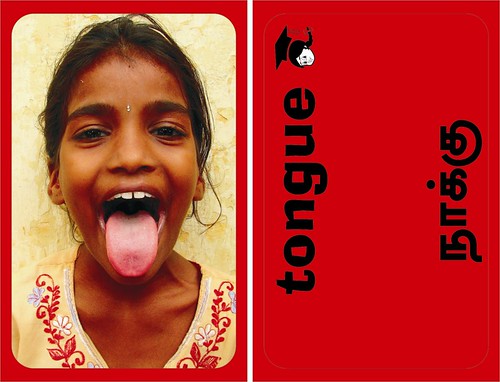
I have used flashcards a lot as both an English teacher (several years ago) and as a learner of Japanese. Here's an example of a flashcard:

Aid India - Eureka English Team - Bilingual Body Parts Flashcard - Tongue

I found this one here. It looks like it's a flashcard being used by a learner of English from India. The learner looks at one side of the card, sees the image, tries to remember the English word for it, and then checks the answer on the reverse of the card.

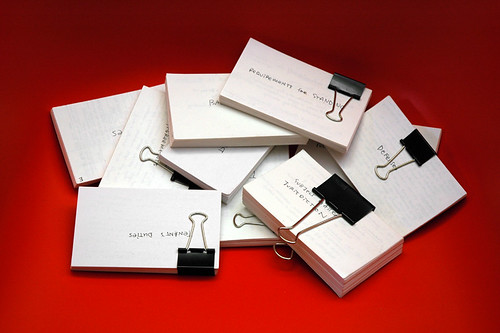
If you make many flashcards, you might have something like this:

I hope I never have to look at these again

Now, here's the problem: You can practice these flashcards whenever you want, but when should you do this? How often? Which cards?

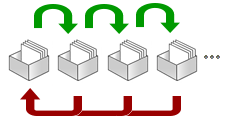
One attempt at answering these questions was given by Sebastian Leitner in 1970. He proposed a system where you get a number of boxes and line them up. You put all the cards in box 1. Cards in box 1 are reviewed often, maybe every day. Cards in box 2 are reviewed less often, maybe every 3 days. Cards in box 3 even less - maybe every 10 days. etc.

If you answer a card correctly, it moves to the second box. If you answer the card correctly again, it moves to the third box etc. If you get any card wrong, it goes back to the first box.

Wikipedia Article on Leitner System

The general principle is that you spend less time looking at cards you know well and more time looking at cards you find difficult. In this way, you maximize the amount that you remember, and minimize the amount of work you need to do. This general technique is called Spaced Repetition.

Leitner's system is a simple example of Spaced Repetition. More sophisticated techniques ask how easy it was to recall the answer. Was it hard, normal or easy? If it was easy, the card gets scheduled for review very far into the future. Difficult cards are scheduled sooner.

Anki Screenshot

Of course, computer software is very good at organising this for you. There are many flashcard programs out there and many of them use Spaced Repitition. I've used quite a few of them but 3 years ago I started using Anki, and I'm still using it today.

If you want to find out about Anki, I recommend watching the introductory videos on the website.

Wednesday, August 11, 2010

Mr. and Mrs. Wright Search for the Right Baby Name

My wife and I are struggling to find a name for our baby, due in January. Boys names are particularly difficult if you're looking for a name that works in both Japanese and English. We don't know the sex of our baby yet but if it's a boy, we may struggle.

My wife really liked the name "Sky" because it sounds nice in Japanese - スカイ - and you can choose some beautiful kanji for it:

澄 meaning "clear" or "translucent" and

海 meaning "the sea"

So 澄海 could be a way to write the name Sky, meaning a clear sea, which is a lovely image for the sky.

Very poetic. However, I've never heard of the name in English and I'd rather not imitate the Hollywood couples that give their kids very strange names.

But then I remembered the Isle of Skye, a beautiful island off the coast of Scotland. I thought that if we spelled the name "Skye", then I might be willing to concede the weirdness point in order to insert some Scottish influence. Ridiculous, I know.

But then it dawned on me. For the Japanese, the L sound and the R sound are indistinguishable. A "light" is pronounced in exactly the same way as my surname, "Wright". Indeed, lights are often called ライト (raito) and this is exactly the same as my surname. A source of much amusement for our friends and the butt of many a joke at our wedding.

If we named our child Sky Wright, it would inevitably be pronounced Sky Light in Japanese.

Back to drawing board.

Friday, April 23, 2010

Chocolate Sparkling

In my continuing quest to try all of the strange and wonderful drinks that come out here in Japan, this morning I spotted a new one in a vending machine on the street.


Chocolate Sparkling. Imagine putting some poor quality chocolate in your mouth and then taking a swig of soda water. That's exactly how it tastes.

Verdict: horrible.

Thursday, April 15, 2010

Organising Office Parties

I've written about using name seals (inkan) in Japan before. Their main use is for stamping documents saying that you've read the contents and approve. They're also used in other non-official circumstances like this one:


You print out a schedule or calendar and get everyone to stamp the days that they're unavailable. The person in charge of organising the event or party uses this to work out a suitable date. In this case, the party is being held to welcome me into the department I've been newly assigned to. Whenever someone enters the company or moves to a new department, this always happens.

All of the official documents come round on clipboards just like this one. In those cases, the contents are obviously a lot more serious and formal. Once everyone has read it and approved, it usually goes up to the CEO and when he stamps it, it comes back down to us mortals and we file it away.

Wednesday, April 14, 2010

Salt & Lime for Breakfast

Kirin have brought out a drink that I haven't seen before. Picked it up from the conbini on the way to work. Salty Lime in Japanese, Salt and Lime in English. It tastes exactly like it sounds. I like it.

Saturday, March 27, 2010

A Funeral In Japan

I guess I’m lucky to have a very good relationship with my father in law. A retired primary school teacher, we share an interest in education and the Japanese language. When I go to visit with my wife, he and I are often the last two at the dinner table, sipping sake and talking about the origins and meanings of kanji.

It was with great sadness that I learned the news that his oldest brother, Seitaro, passed away. The news was sad but not unexpected - my father in law is in his sixties and is the youngest of seven brothers and sisters. His oldest brother was around twenty years older than him and his health had been gradually deteriorating.

I was invited to the funeral with my wife and after negotiating a half-day off work from my employer, we took the bullet train down to Shizuoka to attend. When our taxi pulled up to the family home, there was crowd of around 100 mourners clustered around the house. As the head of the family and as an important member of the local community, Seitaro’s funeral had drawn a large number of people. We were a little late in arriving, which I felt bad about, and as we hurried into the house, the coffin was being lifted into a bus that would transport it and close family to the crematorium. These close family members were Seitaro’s sons, his daughter and his brothers, each of whom was given an item to carry by the Buddhist priest.

Everyone else boarded a different bus to follow the coffin to the crematorium. When we arrived, it was a strange experience to have to wait for the family in front to finish. I watched through the glass walls as a much smaller family group gathered around the coffin as it was inserted into the cremation chamber. Soon, we were next.

First, the coffin was transported into a side room. On the top of the coffin was a small window revealing Seitaro’s face. Everyone was encouraged to take turns to look at him and say their goodbyes. This was the first time that I had seen a dead body. My grandmother passed away last year and my wife, who loved her dearly, was surprised and even a little upset that there hadn’t been the same opportunity to say a final farewell. I felt nervous about saying the right thing and having the right reaction. I was told that seeing Seitaro’s face allowed people to see that he was sleeping peacefully and that he wasn’t in pain. An appropriate thing to say is, “安らかな顔ですね” (He has a peaceful face)

The coffin was then transported into the main chamber, where there were several slots in the wall. Our large group gathered around the end one for the next part of the ritual. The worker stood by the coffin and spoke to the crowd and at several points everyone’s head was bowed and their hands put together in prayer. I glanced at the people around me and felt the palpable sadness in the room. Although I had not known him well, I couldn’t help but feel the sorrow wash over me too, especially when I looked at my father in law’s face as he watched the coffin slowly pass through the doors to be cremated. He was gone.

What followed was a change of mood as everyone filed out and moved to a large dining area, much like a school canteen. Everyone was given a bento to eat and we sat eating and drinking, waiting for the cremation to finish. Here the conversation was light and much more relaxed than I might have expected. A funeral is an opportunity to meet people that you might not normally see and I was introduced to many who I hadn’t met before and who, after my marriage last year, are now my family.

After about an hour, the cremation was finished and the family returned to put the bones into the urn. The family lined up in pairs and each pair used chopsticks to pick up a bone from the tray of ashes and deposit it in the urn. This is the only situation where it is acceptable for two people to use two pairs of chopsticks to hold the same object. Doing so in any other situation is a major faux-pas in Japan. Once the bone is put in the urn, the pair turns and passes the chopsticks to the next pair.

With this finished, the urn was carried by Seitaro’s son back to the buses and we were driven to the family’s local temple. It was a beautiful day with blue skies and clear, fresh air. The temple had a small but pretty garden in front of it, lined with flowers. We made our way inside, where the men sat on the right and the women sat on the left. I placed myself at the back and sat down on a small cushion on the tatami floor. I looked around the wooden interior of the temple and noticed how clean and beautiful it was. The sun’s rays arced through the large entrance and from this a gentle light permeated the small space. The men and the women faced each other. In between, six Buddhist monks sat, three on each side, each holding a percussion instrument. Another monk sat at their head and commenced the chanting of the sutra. At various intervals in the sutra, the instruments would be played in time.
800pxthealtarofthejapan[1]
Unfortunately, the time allotted to my wife and I by our employers had run out and we had to make a quiet exit to return to Tokyo. It was a shame because my father in law had a written a speech that he wanted us to hear. Although we didn’t get a chance to do so, I was sent a copy and I was greatly moved after reading it. Being the youngest sibling, my father in law’s parents had died when he was quite young and his eldest brother had been like a father to him. He stood by his side as he was the first person in the family to go to university and to be recruited in the city as a school teacher in the city. (In Japan, a school teacher is a highly respected title to have). He even attended the interview with him and said, “Let me talk to the headmaster in this interview, I’ll take care of it”. Unthinkable nowadays.

These events and others were recounted in the speech. The first words spoken were “兄ちゃん。ありがとう。ご苦労様でした” (Nii-chan. Arigato. Gokurosama deshita), which I found both moving and interesting. Nii-chan is an affectionate term for one’s older brother. Gokurosama is said to people when they’ve done a good job or worked hard and expresses appreciation. I’d usually heard it in the context of employment and it surprised me to hear it in the context of someone’s life.

In the afternoon and evening that followed, everyone gathered for lots of food and drinks and I was very sorry to miss out on this. My impression of the day was that although there was great sadness at the passing of a loved one, there was also great solidarity and acceptance. I felt privileged to be a part of it.

Picture source: Wikipedia

Saturday, August 22, 2009

What’s the point? Electronic Money and Point Systems in Japan

This blog post has been written in response to a request for tips on how to live frugally in Japan. Those of you who don’t live in Japan may wish to skip the “What you can do” sections.

When I was a wee boy, I was given a wallet as a present. It was my first wallet and I immediately wanted to fill it up so I could feel more grown up. I received about 10 pounds a week for delivering newspapers and that went inside. Any pocket money I was given also went in. There was one thing that bugged me though. Since I had no credit cards or cash cards, I had nothing to put in the slots dedicated to them. I remember that I was delighted when I was given a library card and put that in.

Oh, how times have changed. I now have the opposite problem. I have so many cards that my wallet is full to bursting and I have another card holder just for containing the overflow. I’m sure that many people experience this problem but in Japan, it’s even worse and I’ll explain why.

Those of you in Japan may not realise this but the price of goods that you see in shops isn’t the lowest price that you can pay for them. Just about everyone in Japan is participating in a game that allows you to pay less. Welcome to the Japanese world of loyalty cards.

In Japan, loyalty cards are often called point cards. If you’ve seriously looked into mileage cards for airlines, you won’t be surprised to hear that this is an insanely complicated subject. Japanese magazines frequently publish articles explaining which point cards offer the best value and how they work. Loyalty systems such as these also tie in with credit cards, mileage cards, electronic money* (see explanation below) and public transport commuter cards like Suica and Pasmo. The magazine Nikkei Trendy has a 47 page extravaganza in the edition that is out right now.

What you can do: the basics

The easiest thing you can do is get yourself something to hold a large number of credit cards and start filling it up with loyalty cards for every shop you go to. I was very concerned with spam when I started doing this because in order to get these cards, you often have to fill out a form giving your address and phone number. I’m happy to report that I’ve never been called by marketing teams. We get a lot of spam mail in the post, but I think that the vast majority of this is for local services and everyone in the building gets it. What I often do when filling out applications for point cards is to pretend I don’t have an email address and I miss out a crucial part of the postal address, like my apartment number.

Whenever you go shopping and make a purchase, hand over your loyalty card and get the points. Usually points are accepted in lieu of cash when making your next purchase. A few days ago at the supermarket, I didn’t want to mess around with small change, so I paid 4000 yen in cash and paid the rest using my points.

Point cards have alliances like airlines do with mileage cards. So you only need one card for many shops. One of the biggest, that you see all over the place, is the T-point system started by Tsutaya, the video rental store. There are a large number of shops in this alliance. Some of them only allow you to collect points (貯める) and some of them allow you to pay with points too (使う). You can use T-points to pay for things and you can also exchange them back and forth (交換できる) with other point systems like mileage at ANA.

What you can do: becoming a point ninja

If you really want to go to town with points, the best thing to do is pick up a magazine where the writers have done the research for you. Nikkei Trendy has published quite a few articles and probably contains the most detail.

The trick is to combine points with credit cards, electronic money and public transport cards. Credit card companies will often team up with point systems and offer deals to make their cards more attractive. Beware though. These deal sweeteners are usually combined with more punitive interest rates so don’t get one of these credit cards if you’re not planning on paying the bill in full every month. If you can pay in full, you have nothing to worry about and it won’t cost you anything.

There are three circumstances where you can collect points:
  1. When you charge your electronic money card or public transport card using your credit card.
  2. When you purchase items
  3. When you ride the train or bus
Ideally, you want to cover all three bases. Here are some tips:
  • When you charge your Suica/Pasmo, don’t use cash at the machine. Instead, set up auto-recharge, which will bill your credit card and refill the balance on your card when it drops below a certain level. You get points for every recharge. You can use these points to pay for subsequent charges of your Suica.
  • Don’t buy stuff directly from Amazon or Rakuten or other online retailers. Instead, access these stores through a points mall, which will multiply the number of points you receive. In some cases by up to 17 times:
    Oki Doki ランド

    永久不滅.com

    オリコモール

    お財布.com

    yosoo.net

    SBIマネーワールドポイントモール

    ドル箱

    and many others..
    Only the first three can be used to access Amazon.co.jp and those three all let you exchange the points for JAL air miles. 
  • Don’t pay for stuff with cash in convenience stores. You could use your credit card, but the quickest way is electronic money. Each chain of convenience stores supports a different player in the electronic money space:
Edy: the dominant player, supported at all convenience stores
Waon: the new kid on the block, supported at Family Mart and Ministop. Growing rapidly.
Nanaco: Seven Eleven
Suica/Pasmo: Most stores
  • If you haven’t done so already, set up air miles accounts with an airline in each of the three global alliances. That way, whenever you fly, no matter which airline you use, you collect air miles using the relevant account. If you’re living in Japan, at least one of these air miles accounts should be JAL or ANA. JAL are part of the One World alliance and ANA are part of Star Alliance. There are credit cards connected to both JAL and ANA. Get one or both and get air miles each time you use it. You can also transfer points from other schemes to air miles.
Those are some general tips and avenues of investigation. Here’s what I’ve done:
  • I already had an air miles account with BMI, who are part of Star Alliance. I therefore chose JAL instead of ANA. I got this credit card (the one on the left), which credits my JAL air miles account with air miles every time I use it. I also get miles when I use it to recharge my electronic money cards.
  • The credit card I bought comes with a WAON card. Every time I use it at the convenience store, I get 15 miles. If I use other electronic money cards, like Edy, I get 10 miles.
  • I have applied for the Tokyo Metro To Me Credit Card that offers an auto-recharge facility for PASMO. Every time it auto-recharges, every time I use it to ride public transport and every time I buy a new commuter pass, I get points. These points can be used to make subsequent purchases. You can also exchange these points for ANA air miles.
  • I live on a subway line where I have to use PASMO to get my commuter pass, I can’t use SUICA. SUICA is generally far better than PASMO with wider acceptance and better deals on credit cards and points. This card gets good reviews, although it is JCB, which is useless abroad.
  • I plan to also apply for an Edy card for the convenience stores that don’t accept WAON. I’m just trying to figure out the best one. A list of the different options is here.
Hopefully the above will give you some ideas if you’re a permanent resident of Japan. There are so many different options and I’m not sure if I have the best combination.

Why are loyalty systems so huge in Japan? Are they good for the economy?


I’m sure that the reaction of many readers will be, “What a hassle, I couldn’t be bothered with that”. It’s different here though - diligence is definitely a Japanese character trait. Of course, there are lazy Japanese people, but I’d say the majority always carefully do their duties and chores. Public facilities are always clean and efficient because of this quality.

It’s easy to see how point systems appeal in Japan. Effort and diligence are rewarded. It’s as simple as that. I try explaining to people that companies budget for these loyalty schemes by raising the basic price level to accommodate the discounts. If they didn’t bother, we could all pay less and save time too. Despite these attempts, the general attitude is that getting the best deal is a game and that point schemes make this interesting. It’s all very popular.

I’ve been wondering recently about the effect that the point systems have on the Japanese economy. As long as loyalty schemes are small scale and cover individual companies as they generally do in the west, I’m sure the effect is small. However, when you have enormous schemes like T-point, whose participating companies must account for an enormous amount of revenue in total, the effect may be much larger. How do you measure inflation when people are paying prices that are lower than those reported by the companies? Japan’s deflationary problem is well documented. Could it actually be worse than reports suggest due to points systems? Maybe I’m taking things too far but I really can’t emphasize how huge this is.

* Electronic money (電子マネー) is the Japanese term for IC chips inserted into cards and mobile phones, allowing you to tap contact areas and have the money taken from the chip wirelessly. In most other countries, this technology is restricted to public transport cards like Oyster in London and Octopus in Hong Kong. In Japan, the equivalents in Tokyo are called SUICA, for Japan Rail and PASMO, for the metro. These are now integrated so you can use either anywhere and you can use them on the bus too. There are lots of other equivalent cards in different areas of Japan like ICOCA and PiTaPa in the Kansai area and Kitaca and SAPICA in Hokkaido. Public transport isn’t the only area where you can use electronic money, you can take your SUICA card and use it in shops and with vending machines too. There are also other electronic money service vendors, like Edy, who offer the same service, but you can’t use these cards on public transport.


Photographs taken by (in order of appearance)

Friday, August 7, 2009

The Eternal Boy Band

Imagine, if you will, the boy bands that were popular in the early 90s. For those of you in the UK, that would probably be Take That. For those of you in the US, perhaps New Kids on the Block? Backstreet Boys? For those of you elsewhere, I have no idea.

Now imagine that these bands are still popular now, making music on a regular basis.

I know. The horror.

Don’t stop there though. Imagine further that members of the band star in dramas on TV every year. Imagine that they turn up as the lead actor in many movies too. Imagine that the band has its own variety show on TV every week that lasts for several hours, where they cook dinner for Hollywood celebrities, do comedy sketches and perform their music. Imagine that now, after almost 20 years, a double chinned and slightly portly Gary Barlow or New Kid is on countless billboards and television advertisements.

Nooooooooooooooooo! Pleeeeeaaase!

In Japan, this is a reality. Allow me to introduce, if you haven’t heard of them already, the band called SMAP.

Masahiro Nakai, Takuya Kimura, Shingo Katori, Tsuyoshi Kusanagi, Goro Inagaki

In typical Japanese English that makes little sense, SMAP stands for “Sports Music Assemble People”. The group consists of five members, each of whom Japanese people know very well. As I’ve discussed previously, social rank is very important in Japan and your age is a big part of determining this. Therefore, it is interesting that most Japanese people know the age ordering of the members and they definitely know which SMAP member is the oldest and which is the youngest. The eldest is Masahiro Nakai, who is the leader and is 36! (Incidentally, he is absolutely terrible at singing. Simon Cowell would destroy this man.) The youngest is Shingo Katori, 32, who is the clown of the group.

By far and away the most popular member is Takuya Kimura, or Kimutaku for short. When I studied Japanese in a language school in Tokyo, all of the female students from the Asia region (and some from outside Asia) loved this guy. He is Japan’s Brad Pitt. Disgustingly talented: he acts well, sings reasonably well, plays sports well and generally does everything pretty well.

SMAP are making waves again with a new series of advertisements and commercials for mobile phone network operator Softbank. Softbank bought Vodafone Japan a few years ago and are the smallest of the three main operators in Japan. They have been launching a number of very aggressive advertising and marketing campaigns in the last few years. Cameron Diaz and Brad Pitt have featured in many of their television commercials but now they’ve brought out the big guns: SMAP.

On the 1st of August, at 18:59, a television commercial lasting an incredible 60 seconds, unusually featuring the entire group, was broadcast simultaneously on 124 channels to the whole of Japan. The blog Naked Tokyo commented, “Pass the crackpipe”. Here it is:

I shudder to think of how much that cost Softbank. Let’s hope that they’re not leveraging themselves too hard with all of this marketing. So how can a boy band be so popular for such a long time? I think there are three important factors.

One is that Japanese pop stars tend to age well. Takuya Kimura still looks like he’s in his 20s to me. The other more important factor is the working culture. Japanese workers traditionally have the same job for life. The entertainment industry is influenced by this and there are many comedians and performers who have been in the business for a LONG time.

A good example is the comedian Tamori, who is 63 and appears on television every day on live variety programs. Due to a problem with one of  his eyes, he always wears sunglasses and they have become his trademark. Hilariously, he has even worn them when he has appeared in samurai dramas, set in times when sunglasses didn’t exist. Legend has it that he hasn’t taken a substantial holiday since 1984! He’s really entertaining to watch and like all Japanese comedians, comes across as a really nice guy.

The third factor is the company that holds SMAP and all idol groups on a leash: Johnny & Associates. Johnny Kitagawa and his talent agency recruits and trains male idols in Japan. They have enormous power in the entertainment industry due to their monopolization of male talent for the last 40 years. If you want male performers to appear on your show, you need to go through Johnny, who owns all of them. It’s obvious that SMAP are still a huge money spinner for Johnny and I reckon that his company drives them to continue working hard, despite the fact that any of them could retire right now. I know that if I had their money, and I was working as hard as they do, I would.

Johnny and Associates has been mired in controversy for a long time. In the 90s, a book was published by a male idol accusing Johnny of sexually abusing the young boys that he recruits. Subsequent to that, about a dozen other idols came forward to one newspaper, Shukan Bunshun, and on condition of anonymity contributed to a 10 part series detailing more accusations of abuse. Johnny sued the newspaper for libel and in 2002 won the case and was awarded 8.8 million yen (a relatively small amount). No other newspaper or media agency joined Shukan Bunshun in accusation. As one entertainment reporter put it in a New York times article:

"If you're a television station and you don't comply with Johnny's Jimusho's wishes then all the popular stars will be withdrawn from your programs, your variety shows will not get any interviews with celebrities, and your ratings will plummet," said Masaru Nashimoto, an entertainment reporter. "The same thing goes for publications," he added.
Despite these upsetting stories, and my joking earlier, I must give credit where it’s due and admit that SMAP are entertaining. I must confess to watching many of their TV programs and not switching the channel when I could. They do have personalities that make you watch.

Wednesday, August 5, 2009

More Difficulties in Claiming Overtime

In a previous post, I wrote about the work ethic in Japan and how it can be difficult to go home early and take holiday. Today, I’ve made some surprising discoveries about how my company operates.

Every month, I fill out an overtime sheet, writing down the hours that I’ve worked each day. Today, my boss came over and asked me what I was doing in the second week of last month. My overtime sheet stated that I had worked extra hours during those days. I told him that I had no idea and that I couldn’t remember. When I leave the office, I make a note of the time I leave. I don’t make a note of what I’m doing.

It turns out that my boss has been filling out his own excel spreadsheet for the past year that I have been working with him. For every day that I claim overtime, he has to write the reason why I’m working overtime. Every manager in the company has to do this. I couldn’t believe it, he’s been doing this for a year, and this is the first that I know about it! No wonder he gave me a funny look the first time I handed in my overtime sheet. Compared to other people who work the same hours as me or longer, I think I must be claiming much more.

On first inspection, there might be an argument that this is a good thing. If managers are told to report the reason for overtime, they might encourage their workers to go home when there’s nothing to report, and think carefully about why their workers are still in the office.

In reality, managers are just going to pass this responsibility on to the workers. This has happened to me. Every day, I’m going to write down exactly why I’m still in the office. I think that my colleagues, and the typical Japanese worker, will find it more difficult to claim overtime if they have to say why every time. If they’re still in the office simply because their boss hasn’t gone home yet, they definitely won’t claim. They will also worry about their manager coming over and saying, “Why were you here until 10pm working on this? Why didn’t you finish earlier?”

If Japan is going to address the working hours issue, the first thing that must be done is to face up to the facts. Working hours should be logged impartially by a third party. Making a worker log them himself/herself is bad enough. Making the workers write down why is even worse.

(Photo taken by inoc)

Monday, August 3, 2009

Applause for the New Employee

I've posted before on how hard Japanese people work, and how you find yourself in an environment where you are encouraged and supported to do so. It all starts on the first day, when you are fully indoctrinated into the company...

As you can imagine, I was quite nervous on my first day at this company last year. It started with a private chat with one of the more senior members of the company. He and I sat opposite each other in the middle of one of the large meeting rooms. It was the first time that my company had hired a westerner and he was very curious about me. He asked me all of the questions that I had already answered at the interviews – “Why did you come to Japan?”, “Why did you apply to this company?” etc. I must have given some good answers because he has been very friendly to me ever since. Whenever he passes my area of the office, he comes by and asks me how it’s going, how I am, and says “Gambatte!” with a big grin and slaps me on the shoulders.

After this informal chat, I was given a tour of the office and introduced to each department. Two new employees joined today and the same thing happened to them. A member of HR guides you round and introduces each department and its boss. Everyone in that department will stop what they are doing, stand up straight and face the new employee. The new employee then says, “My name is …. I have been recruited to the …. department. Yoroshiku Onegaishimasu.” He then bows and everyone bows in response.


I hadn’t anticipated the tour, but when it happened it was similar to normal introductions in Japan; a bow instead of a handshake and a few standard words and phrases. What I hadn’t anticipated, was the applause that followed! I found it flattering and embarrassing. In my arrogance, I suspected that it might be due to my nationality. I immediately said thank you and put up my hands to petition them to stop! I have since discovered, after the arrival of many new employees, that it had nothing to do with my nationality. Everyone gets applause and this happened today too. I should have just smiled and accepted the welcome.

After the tour of the departments, I was taken into the palatial section of the office that houses the executives. There are five executives in the company and their offices occupy the same floor space as 100 normal workers. They enjoy a lot of privileges and exercise complete and absolute control over the company. Almost nothing is done without their approval or design. The conversations that I had with each of them went well since I knew what they wanted to hear. Every employee I met that day wanted to hear the same thing: an introduction and a promise to work very hard for the company. They wanted to hear that I would join the team and be part of the collective.

Friday, July 10, 2009

手締め Tejime

At the end of the nomikai in my last post, the evening was brought to a close with an activity called tejime. The Japanese encyclopedia describes tejime as a celebratory rhythmic clapping of hands that is done to mark the successful closing of an event.

I first came to Japan in 2003. I’ve spent a lot of time visiting and I studied in Tokyo for a year and a half. However, it wasn’t until I started doing business in Japan last year when I encountered the tejime. You can imagine my bafflement as everyone around me commenced the ritual. Take a look:

This example shows the tejime closing the end of a festival in Japan. It can happen after various events such as weddings, business parties and of course, company nights out.

I was confused though. The tejime seemed to have several different forms and different names. This is Japan; there must be rules for these things. So I asked my colleagues and even they weren’t too sure. We found this site though, which cleared things up.

The tejime usually starts with a small speech, where the leader thanks everyone for coming and says the appropriate words. He is then supposed to say the following:

「それでは皆さん、お手を拝借」 Everyone, please ready your hands.

He then says, “Yoh~ !”, which you can see in the video, and everyone claps a certain rhythm. There are a few of these rhythms though.

We’ll start with 三本締め(“Sanbonjime”). This is what you saw in the video above. The rhythm is like this:

and those two bars are repeated three times.

The next is 一本締め(“Ipponjime”). For those of you who can’t read Japanese, you may still notice that the only difference is that 三 has turned into 一. Sure enough, instead of doing the above rhythm three times, you only do it once.

Some of you who live in Japan may be thinking, “Hang on, I’ve done this before, and we did one where we only clap once”. It’s name is 一丁締め(“Iccho-jime”). However, in the Kanto region, which includes Tokyo, it is also called Ipponjime. This leads to some confusion for people like the author of the website I linked to. He has been left on his own when everyone else claps once and he continues the rhythm. In order to avoid the confusion, it can also be called Kanto Ipponjime. Here it is:

The pattern of Ipponjime is 3, 3, 3, 1. The set of threes add up to 9. The number nine has the following character: 九. If you add one more pen stroke (or clap), you get 丸, which is the character for a circle. Therefore, clapping ten times like this is supposed to form a circle and complete the harmony.

九 ⇒ 丸

How do you tell which pattern is appropriate? My colleagues didn’t know the answer to this. The website states that Ipponjime is the standard and this means that everyone is thankful and pays their respects. Doing this three times for Sanbonjime simply means that these feelings are tripled! Sanbonjime is therefore used on those extra special occasions where people want to celebrate the most. The Iccho-jime is perhaps the most frequent in Tokyo and is the least formal.

Incidentally, for those studying Japanese, the “Yoh~” that you always here before the clapping was originally 祝おう, meaning “Let us celebrate”.

I really like this little ritual and it’s easy to see it’s appeal. It’s comforting to know that the event is officially over and there’s no milling around with people saying, “OK, I’ll take off now”, and people leaving in dribs and drabs.

Tuesday, July 7, 2009

Doh is for DONUTS!

During my time at my present employer, I have of course been drinking with my colleagues on quite a few occasions. It’s always fun and we have a laugh. Last Tuesday was different...

With the arrival of the hot weather in Japan, the office has gone into “cool biz” mode. The temperature gauge has been turned up and the ties are off. The Summer is also the time for an event called 暑気払い(“shokibarai”). This phrase literally means “to beat the heat away” and it’s an opportunity to let out all of the pent up heat and the stress of work. Tuesday was the first time that I had participated in such an event.

Just like any other nomikai, the first thing to do is to assign a person to the role of kanji (幹事). The kanji must organize everything and co-ordinate the entire event. It’s a real pain and naturally the job usually rotates between the more junior members, of which I am one. For this reason, I was surprised when my boss took the responsibility.

The first thing the kanji must do is establish the date for the event. This usually works by passing a calendar round the office. Each person takes their hanko and stamps all of the dates that they are unavailable. The calendar is passed to the highest ranking person first and it works its way down.

After that, the kanji sent the following email, which gave me an indication that this was not the usual nomikai:

営業部暑気払いの開催日が6月30日(火)に決まりましたので、 取り急ぎご連絡申し上げます。

お店は丸の内界隈のお店を予定しておりますが、追ってご連絡いた します。

当日は1人1芸を、___さんのみ2芸(1芸では足らぬとの弁)をよろしくお願いします。

This to quickly inform you that the date for the marketing department’s shokibarai has been set to the 30th of June (Tuesday). We are planning on choosing a venue in the marunouchi area.

I would like to request that each participant prepares one performance, with the exception of Mr. ___ who must prepare two (the consensus was that 1 was insufficient).

“Performance? What the *$#?”, I thought to myself. This was the first time that such a request had been made.

Next, came the following email:

営業部の皆様

暑い季節を目前に控え、鬱陶しい梅雨空を吹き飛ばすべく、営業部・懇親会を開催することになりました。

皆様ひとり残らず、奮ってご参加くださいますよう、宜しくお願い申し上げます。

日時:6月30日(火) 19時スタート

場所:パセオ・銀座店(カラオケ居酒屋)

http://www.pasela-ginza.com/

個室、カラオケ機器、ダーツ ゲーム付です。(ダーツはワンゲーム100円の課金) なお、飲み放題2時間限定(!)、でありますので、遅刻などなきよう、この日ばか りは仕事を割り切って、18時30分頃に、みんなで揃って、こっそり退社と致したく、ご協力宜しくお願いいたします。

幹事・___

With the Summer heat near at hand, in order to drive away the overcast and rainy skies, we are holding a party for the whole marketing department.

I would like to invite everyone, without exception, for active participation in the event.

Day/Time: June 30 (Tue) 19:00 Start

Place: Paseo, Ginza (Karaoke Izakaya)

http://www.pasela-ginza.com/

It’s a private room, with a karaoke machine and darts. (A darts game costs 100 yen). We also have an all-you-can-drink deal for 2 hours(!) so lets all finish our work on time and be sure that we’re not late. It would be very much appreciated if we could meet at 6:30 and quietly exit the office.

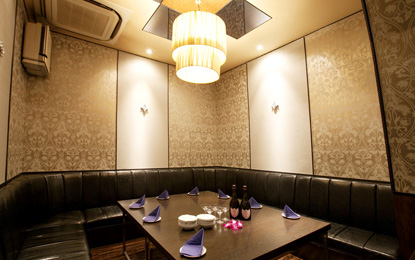
Sure enough, on the day, we had the unusual pleasure of everyone finishing on time and we quietly met on the first floor of the building as instructed. The karaoke room was quite large and the seats were arranged in a U shape, with a flatscreen TV and karaoke machine at the other end. Our deputy director, who likes to drink, had been looking forward to this event for quite a while and it was reportedly his idea to go for karaoke. As soon as the first round arrived, he enthusiastically stood up and kicked the evening off with a speech and a hearty “Kampai!”.

I think this is the room we were in

We then spent two and a half hours singing and drinking a lot. We were also served a course meal, which was very good, but lacking in quantity. Obviously everyone got fairly hammered and after Japanese pop, came some Enka singing from the older participants. Once one person was finished singing, the deputy director that I mentioned earlier started a trend where the singer’s name was chanted, and people clapped in time as the individual was forced to down his/her drink. I’ve been drinking several times with my department and this was the first time that this had happened.

One peculiarity of going out in Japan is that there are some people who can’t drink. When I say “can’t drink”, I don’t mean that these people can drink less than other people, I mean that they literally can’t drink. There is one guy in our marketing department who never drinks a drop. He says that if he has one beer, it will take him out of the game for the rest of the evening. He is a legend in the office for being a really funny guy and he’s also reasonably bulky (in a good way!). You would expect him to be able to drink substantial amounts. He spent the evening drinking ginger ales and cokes and acquitted himself admirably with a few renditions of Japanese pop songs where he was hilarious in each.

Things progressed to the next level, where a new song was introduced. It goes something like this: (to the tune of “Do Re Mi” from a Sound of Music)

ドーはドーナツのドー♪

レーはレモンのレー♪

ミーはみんなのミー♪

ファーはファイトのファー♪

ソは青い空ー♪

….

Doh is for DONUTS!

Reh is for Rehmon!

Mi is for Minna!

Fa is for Faito!

So is the so from Aozora!

Rehmon = Lemon, Minna = Everyone, Faito = Fight, Aozora = Blue sky

Before singing the song, the victim had several drinks lined up in front of him, with the next drink being of a smaller quantity than the previous. This made the line up look like a xylophone. Everyone sang “Doh is for DONUTS!” and the person had to down the first drink. Then everyone sings “Reh is for Remon!” and the second drink is consumed etc.

I managed to avoid that one but the non-drinker in our group wasn’t as fortunate. Instead of beers, he got a ginger ale, a coke, a bowl of salad and a mango mouse pudding.

Thursday, June 25, 2009

Signed, Sealed, Delivered

My signature is atrocious. Anyone who takes a moment to look at my hasty scribble will surely snicker at the childlike mess of pen strokes that are somehow supposed to suffice as evidence of my identity. I’ve tried to improve it and to craft something a little more… distinctive. Something with a bit more aesthetic appeal than the scrawl I produce. But to no avail. Even Japanese people scoff.

Luckily, in Japan, in the land where the writing is complex, where the characters are beautiful and where calligraphy is an art form, a signature is not necessary. Instead, the Japanese use a seal to stamp official documents. This seal is called an “inkan” or a “hanko”. There are many different kinds but they are all stamps that print a name in red ink on a white background.

When I started working here, I didn’t have a seal and my colleagues decided to give me one as a gift. It’s an absolutely essential piece of office equipment and I use it many times every day to stamp internal documents. For seals used in the office, Japanese people have their surname engraved in a circular seal that is about a centimeter in diameter. Japanese surnames almost always have two characters, sometimes one and rarely three. Western people have several choices when creating their own seal.

  1. Write your name in katakana and put this in the seal. Katakana is a phonetic syllabary that is used to spell out the pronunciation of foreign words. Foreigners almost always write their names in katakana. In converting to katakana, Japanese syllables must be chosen so as to approximate the original pronunciation as closely as possible. If you choose katakana for your hanko, you will probably only be able to squeeze in 3 characters on two lines. My name is アンドリュー, which is 6 characters and just fits. It is pronounced, “an-doh-ryew”.
  2. Choose kanji for your name and put this in the seal. Kanji are characters imported from China that have meaning and can have multiple pronunciations in Japanese. For example 川 is river and 木 is tree. 木 can be pronounced “ki” or “moku”. Since there are various characters for a given pronunciation, foreigners have many choices when attaching kanji to their names. My friends attached the following kanji to my name: 安藤龍. Approximate meanings are 安: tranquil, 藤: wisteria tree, 龍: dragon.
  3. Write your name normally in the alphabet and put this in the seal. I was told that you can have up to two lines with up to 6 characters on each line. My surname and first name both have six characters. Perfect.

I went for option 3 and this incurred a surprising amount of fascination from my colleagues. They had never seen a seal with English characters before. Here it is:

Hanko Stand

Hanko Stand Close-up

If you choose option 1 or 2 then you’ll also have to choose a font and style. To illustrate the choice available, I found some samples where the name 徳川 (Tokugawa) is used. Tokugawa Ieyasu is a famous character from Japanese history.

認め印/篆書体 認め印/太枠篆書 認め印/吉相体 認め印/古印体 認め印/隷書体
篆書体 太枠篆書体 吉相体 古印体 隷書体
ていしょたい ふとわくてんしょ きっそうたい こいんたい れいしょたい

If you’re like me, you’ll find some of these hard to identify with the original characters. In the office, some of my colleagues use seals with styles that are difficult to read. Documents are passed round and once you’ve read the document, you're supposed to stamp it. When I started out, it was difficult for me to tell who had read the document and who hadn’t. I therefore couldn’t work out who to pass it on to. I’m used to it now but it was a challenge. I’ll do another post in the future on how this document stamping exercise works.

Most people will have several seals. One or two for the office, one to keep at home by the door to sign for deliveries, one official version which you use for important documents and maybe more. Your official seal will be used for things like renting an apartment, buying a vehicle or getting married. The official seal is called a “jitsu-in” and these are closely regulated by law. The size, shape, design and font are all specified to be within certain limits. There is also a “ginko-in”, which is the seal used for opening a bank account.

Carving seals is an old profession in Japan and most people go to a specialist to get their jitsu-in and ginko-in. If you have a common name, then you can buy a seal to put by the door from your local miscellaneous goods store:

Hanko Stand  
Hanko Stand Close-up

These days, seals can also be ordered online but a specialist will be able to design something unique to you. This provides security, especially important with the bank seal. It’s important to keep your official seal in a safe place since it is proof of your identity. It’s easy to forge a signature but it’s easier to stamp a seal if you’ve got it to hand. In my company, the important seals are kept in a safe.

Friday, May 29, 2009

Are Spiders and Octopuses Lucky in China?

After Singapore, we flew to Hong Kong and stayed there for a couple of days. There’s something about Hong Kong that I really like. It’s hard to put my finger on exactly what it is but it definitely has a character that I find appealing. San Francisco, Kyoto and Edinburgh are all the same.

I’m not the only one that likes Hong Kong. Paul Krugman was there at the same time, and he talks about how futuristic the place looks because the city has grown vertically rather than horizontally. (Incidentally, it appears he followed me back to Japan too. Paul, if you’re looking for advice on the economy and want to get in touch, just leave a comment below) Unlike Japan, Hong Kong is blessed with an absence of earthquakes, which allows for the construction of closely packed skyscrapers. With the dense greenery cloaking the Kowloon mountains behind, it makes for an incredible sight. (Click for full screen)

The majority of our meetings were in the loftier section of one of the skyscrapers and we had plenty of opportunities to admire the view. One of our clients joked that he has the best economic indicator right outside his window. He just monitors the number of tankers and haulers making their way in out of the bay and assesses the economic health of the region. One thing I did notice is that there are is no 4th floor in any of the skyscrapers. There’s no 24th floor either. I think that probably extends to 34, 44 and the rest. In both China and Japan, the number 4 is unlucky. The concept of “luck” is a western one and perhaps “unlucky” is a poor description. The reason for the negative association in both countries is that the number has the same pronunciation as the word for death. The character for 4 is 四. The character for death is 死. In Japanese, both words are pronounced し (shi). In order to avoid the association, the Japanese even go so far as to provide an alternative pronunciation for the number 4. You can also pronounce it よん (“yon”). The practice of excluding the 4th floor in a building is similar to that of excluding the 13th row in an aircraft. I’ve always wondered if anyone on the 5th floor gets upset. After all, if you’re on the 5th floor, you’re actually on the 4th floor and to add insult to injury, you’re being lied to.

On the opposite side of the fence, it turns out that two wrongs do make a right because when you double 4, you get 8, which is a very lucky number in both Japan and China. When I was in Hong Kong, I noticed that the number 8 appeared in a lot of advertisements, prices, signs etc. A quick search on Wikipedia, reveals the following trivia:

A telephone number with all digits being eights was sold for USD$270,723 in Chengdu, China.
A man in Hangzhou offered to sell his license plate reading A88888 for RMB 1.12 million (roughly $164,000 USD).

And I’m sure you will remember:

The opening ceremony of the Summer Olympics in Beijing began on 8/8/08 at 8 seconds and 8 minutes past 8 pm (local time)

Interestingly, the reason for the positive association with the number 8 is different in Japan and China. My friend from Hong Kong tells me, and Wikipedia confirms, that the Chinese pronunciation for 8 is similar to the pronunciation for “prosperity” and “fortune”. In Japan, the shape of the character used to represent the number is more important. The Japanese say 末広がり, which means to “broaden towards the end” and can be used to describe increasing prosperity as time goes on. The character broadens towards the bottom and represents this idea.

I wonder if things associated with the number 8, like octopuses or arachnids, inherit the association of good fortune?

Wednesday, May 27, 2009

Solution

If you like puzzles and you haven’t seen my post on Singapore where I shared a puzzle that some clients gave me, please take a look and read no further!

For those of you who have already been thinking about it, here’s the solution:

There are 30 coins in front of the blind man. 18 have heads facing up, 12 have tails facing up. His aim is to separate the coins into two groups such that there is an equal number of coins with heads facing up in both groups.

The blind man takes 18 of the coins and puts them in a group to his left. He takes the remaining 12 and puts them in a group to his right. He doesn’t flip any coins over yet. The trouble is that he doesn’t know how many coins on the left have heads facing up. It could be all 18, it could be 12, and it could be a minimum of 6. What he does know is that the heads that don’t go to the left pile, must be in the right pile. So if there are 18 heads on the left, there are zero on the right. If there are 12 heads on the left, there are 6 on the right etc. To insert some letters: if there are x heads on the left, then there are 18-x heads on the right.

The blind man then flips over all the coins in the left pile. Problem solved. If there were 18 heads on the left then they all turn to tails. If there were 12 heads on the left, then those 12 turn to tails and the remaining 6 turn to heads. To use letters again, if there were x heads on the left, then after flipping all of the coins on the left, there are now 18-x heads on the left. This is the same number as the number of heads on the right.

I like puzzles and I thought that was a good ‘un. Hope you had fun thinking about it.

Sunday, May 24, 2009

Singapore – Storms, English and a Puzzle

I spent the past week in Hong Kong and Singapore on business and I thought I'd write a little bit about these trips.

Arriving in Singapore on the Sunday evening, I was dreading the tropical heat that I knew would greet me. Running around town attending 6 meetings every day in temperatures of up to 36 degrees is a challenge for a Scotsman. I politely suggested to my 部長 (director), that perhaps we could attend the meetings in the same fashion as our clients – with no jacket or tie. I got a firm rebuttal. Fortunately, I had made the wise decision of investing in a summer suit and short sleeved shirts in preparation for the similarly unpleasant heat during Tokyo’s summer.

I had anticipated the heat, but what I hadn’t anticipated were the tropical storms. We were in a meeting on the 15th floor of a central building when quite suddenly, the sky darkened and the heavens opened. We’re not talking about the typical Tokyo drizzle, we’re talking about seriously heavy rain crashing against the windows. Thunder and lightning then began their assault on our exposed position and interrupted my presentation. My listeners were completely unperturbed though and asked me to continue, saying that it would be over soon. Sure enough, after about an hour, the skies cleared. Talking to locals, I was told that these storms occur almost daily so I resolved to carry around an umbrella for the remaining two days. Of course, carrying the umbrella with my heavy bag full of presentation material ensured that the rain didn’t return.

Singapore is slowly becoming the dominant financial centre in Asia and it becomes quickly obvious that one of the main reasons for this is the prevalence of English. Although the vast majority of the population is of Chinese, Malay or Indian descent, English is the official language and is spoken by everyone. If you get in a taxi in Singapore, you can have a good conversation with the driver. If you get in a taxi in Japan or Hong Kong, you end up stabbing a map with your finger. The street signs look identical to those in the States, with white writing on a green background. It’s no wonder that so many American firms choose to set up their Asian hub in Singapore.

Singapore is similar to Japan in quite a few ways. There’s no tipping and you get great service. Everyone smiles, talks to you politely and calls you sir. It felt very safe too.

On the last evening, we were having some drinks with clients and one of them gave me a puzzle. I love puzzles and this is a good one. It took me about 20 minutes to figure it out. Continuing with the theme of Michael’s post last month, I thought I’d share it with you.

A blind man has 30 coins in front of him on a table. 18 of those coins have heads facing up. The remaining 12 have tails facing up. The blind man has to separate the coins into two groups such that the number of heads facing up is the same in both groups. How does he do it?

I can tell you that there are no trick answers to this puzzle. The coins are all perfectly smooth so the blind man can’t feel the pattern of heads or tails using his fingers. Balancing the coins on their edges doesn’t solve the problem either. It’s pretty straight forward when you’ve got the answer but figuring it out takes time.

Answers in the comments or by email!